• Home
  • Archives

Dave Knows Portland

November 29, 1991: Portland’s Vintage Trolley Service Inaugurated

November 29, 2011 by Dave Knows Leave a Comment

Portland’s Vintage TrolleyAfter a 41 year absence, regular trolley service returned to downtown Portland on Friday, November 29, 1991 (The Oregonian, 27 November 1991)

The burgundy cars, with brass fittings, wicker seats and oak interiors, are replicas of the Council Crest street car that ran in Portland until 1950.

Built by Gomaco Trolley Co. in Ida Grove, Iowa, the cars ride on wheels and motors from old Chicago street cars.

“Basically, this technology is all more than 100 years old,” [Bill] Naito [president of Vintage Trolley Inc., the non-profit corporation formed to operate the service] said. “Steel wheels, steel rails, direct electric current and overhead wires.”

Four cars ran daily during the 1991 holiday season.

The new Portland Vintage Trolley service followed a decade of planning and two years of construction. The trolley traveled a 2.3 mile route on the existing light rail line between downtown and Lloyd Center.

The vintage trolley is still running today, offering free rides every 30 minutes from roughly 10:30 a.m. to 5:30 p.m. on Sunday, May 29, July 3, September 4, November 27, December 4, 11 and 18, stopping at all MAX stations on 5th and 6th avenues between Union Station and PSU.

November 28, 1969: Portland Agrees to Take Over Rose City Transit, Transfer to Tri-Met

November 28, 2011 by Dave Knows Leave a Comment

On November 28, 1969 Portland’s City Council entered into an agreement with Rose City Transit and the Tri-County Metropolitan Transportation District (Tri-Met) paving the way for Tri-Met to take over Portland mass transit operation (The Oregonian, 29 November 1969).
With the possibility of a bus strike 48 hours away, the City Council entered an agreement Friday by which the city Monday [December 1, 1969] will begin operating Transit buses for the first time . . .

The council passed a pair of emergency ordinances prepared in advance by City Commissioner Francis Ivancie and the city attorney’s office. They provide:

– Execution of an agreement with Rose City Transit Co. under which RCT will turn over its plant and property to the city at 12:01 a.m. Monday.

– Immediate transfer of the plant and property, following its receipt by to city, to the Tri-County Metropolitan Transportation District.

Before the transfer Rose City Transit was the last privately-owned and operated big-city transit system on the Pacific Coast (Sunday Oregonian, 1 September 1968).

November 27, 1962: Oregon State’s Terry Baker Wins Heisman

November 27, 2011 by Dave Knows Leave a Comment

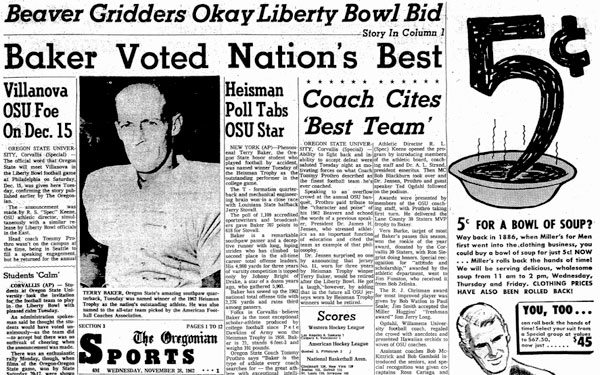
The Oregonian sports page, 28 November 1962Oregon State quarterback Terry Baker received word he had won the Heisman Trophy, as the outstanding performer in the college game, on November 27, 1962 (The Oregonian, 28 November 1962).

The T – formation quarterback and mechanical engineering brain won in a close race with Louisiana State halfback Jerry Stovall.

The poll of 1,109 accredited sportswriters and broadcasters gave Baker 707 points to 618 for Stovall.

Baker is a remarkable southpaw passer and a deceptive runner with long, loping strides who has climed to second place in the all-time career total offence leaders. His 5,980 yards for three years of versity competition is topped only by Johnny Bright of Drake, a star of a dozen years ago, who gathered 5,903.

Bakers has sewed up the 1962 national total offense title with 2,276 yards and rates third among passers.

It was a basketball scholarship that brought Baker to Oregon State, who did not play football his freshman year. Baker was a three sport star at Portland’s Jefferson High School, winning state football titles with the Democrats as quarterback in 1958 and 1959. He pitched for the baseball team that won state in 1959, and as point guard he lead the Democrats to the state tournament in 1959 and 1960.

Further reading:

  • Terry Baker at the Oregon Sports Hall of Fame
  • Terry Baker at Heisman.com
  • Terry Baker at the College Football Hall of Fame

November 26, 2010: City Owned Portland Oregon Sign is Turned On

November 26, 2011 by Dave Knows Leave a Comment

Portland Oregon sign (photo by Wikipedia user Steve Morgan)The iconic sign perched atop the White Stag building at the west end of the Burnside Bridge was purchased by the City of Portland in September of 2010. The deal with Ramsay Signs and White Stag Block LLC saved the sign from an uncertain fate, and was pushed through quickly by Commissioner Randy Leonard in order that the sign would be ready for the 2010 holiday season.

The sign advertised White Satin Sugar when it was constructed in 1941, and over the years played host to several other brands, including White Stag and Made in Oregon. After the city’s purchase the sign, retaining the Oregon outline and the deer, was changed to read Portland, Oregon.

On November 26, 2010, the day after Thanksgiving, Mayor Sam Adams and Commissioner Leonard flipped the switch that lighted the sign, now city owned, that had been dark since October. And of course, the leaping deer’s nose was lit with red.

Photo credit: Portland Oregon sign by Wikipedia user Steve Morgan, used here under Creative Commons Attribution-Share Alike 3.0 Unported license.

November 25, 1948: Ed Parsons Invents Cable Television in Astoria

November 25, 2011 by Dave Knows Leave a Comment

Leroy E. “Ed” Parsons‘ wife had witnessed television in all its glory at a 1947 broadcasters’ convention in Chicago. On the couple’s way back home to Astoria, Oregon she informed her engineer husband that she wanted a television. At that early date there were no television stations on the west coast, and in fact Portland, the large city closest to Astoria, wouldn’t see television until 1952.

In early 1948 a Seattle station, KRSK (now KING), however, announced broadcasting plans. The manager, Bob Priebe, was a friend of Parsons. Working together they determined that an antenna placed atop the eight story Astoria Hotel just might be able to pick up the signal, and with the use of an amplifier, and coaxial cable, Parsons figured he might be able to extend the range of that signal. With permission from the hotel Parsons constructed an antenna, and gave his idea a shot; in his own words:

Well, I strung a cable from the top of the hotel roof over to the three-story building where my penthouse was, and we had the television set in our living room. By the way, going back, after we heard Priebe was going to build a television station, I ordered a television set from Chicago. It was only a 9-inch, black and white set, and I bought it primarily because it was a hi-fi set AM/FM and a record player. I told the wife that we were wasting our money with the television addition, but at least I would try to get her television. It was a Howard set. I ordered it from Chicago and had it flown out to Astoria. Told her it would be a great waste of money, but if you want it, you can have it. Use it for furniture if nothing else.

On Thanksgiving Day, November 25, 1948, KRSK went on the air, and the Parsons and his wife watched cable television. By the crowds his television drew, he knew he was onto something, and extended the cable network throughout Astoria.

« Previous Page
Next Page »

Search

Dave Knows Portland Archive

Copyright © 2026 · Magazine Pro Theme on Genesis Framework · WordPress · Log in