• Home
  • Archives

Dave Knows Portland

December 30, 1950: Governor McKay Dedicates New Sauvie Island Bridge

December 30, 2011 by Dave Knows Leave a Comment

Sauvie Island span dedication photos and headline in The Oregonian, 31 December 1950The Sauvie Island Bridge, the first physical link between the island and the mainland in the island’s history, was officially opened with a ceremonial ribbon-cutting at noon on Saturday, December 30, 1950 (The Sunday Oregonian, 31 December 1950).

Sauvies islanders Saturday dedicated the new bridge which has ended their 100-year isolation from the mainland.

Mrs. J. W. Frater, mother of Governor Douglas McKay and early day resident of the island, cut the ceremonial ribbon to open the bridge to traffic.

Governor McKay, who lived on the island as a boy, in a dedicatory speech called the $900,000 bridge one step in a giant building program which will be necessary to put Oregon’s highway network in the shape to meet the demands of the state’s increased population and industrial growth.

The bridge replaced a nearly 100 year old ferry service, which had its last run on Sunday, December 31, 1950. A new bridge replaced the original in 2008.
December 14, 1915: Portland/Seattle Hockey Rivalry Begins

December 14, 2011 by Dave Knows Leave a Comment

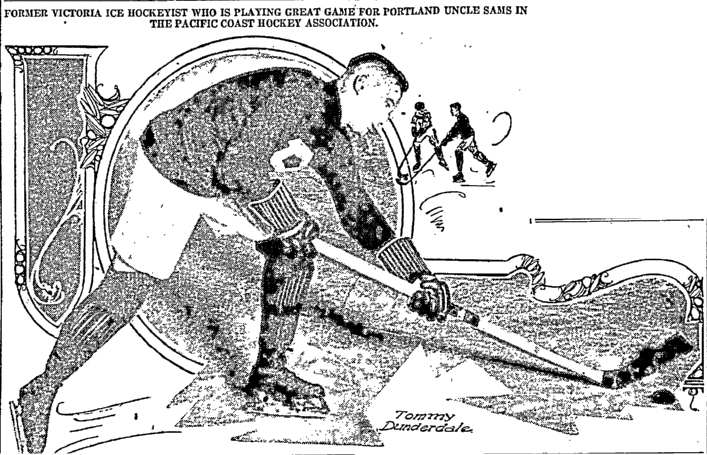
Portland star Tommy Dunderdale in the Sunday Oregonian, 19 December 1915The first hockey game between a team from Portland and a team from Seattle took place on Tuesday, December 14, 1915, when the Portland Uncle Sams, also known as the Rosebuds, traveled North to face the Seattle Metropolitans (Morning Oregonian, 16 December 1915).

“It was a mighty hard game to lose, but we have the opportunity of evening up matters Friday night in the Portland Ice Hippodrome,” said Manager Savage, of the Portland hockey team, on his arrival in Portland early yesterday. His Uncle Sams received a 4 to 2 defeat at the hands of Pete Muldoon’s Seattle ice hockey team in Seattle Tuesday night.

“Up until the last 15 minutes of play we had outskated and outpointed them,” the local manager continued, “and just at a critical moment a penalty weakened our defense. Seattle scored a point and then added another within 15 seconds after the first. We tied it up and then with but four men on the ice wearing Portland uniforms we had two more points scored against us.”

Portland returned the favor, however, three nights later, defeating Seattle 5 to 2 at the Portland Ice Hippodrome (Sunday Oregonian, 19 December 1915).

1915 was the Seattle team’s inaugural year in the Pacific Coast Hockey Association. The Uncle Sams, also known as the Rosebuds, joined the league as the first American team in 1914.

Further reading:

  • The Seattle/Portland Rivalry (pdf) at the Seattle Hockey Homepage

December 12, 1942: Vanport’s First Residents Move In

December 12, 2011 by Dave Knows Leave a Comment

Photos from The Sunday Oregonian, 13 December 1942

The first residents of Vanport, the largest wartime housing development in the country, moved in on December 12, 1942 (The Sunday Oregonian, 13 December 1942).

Mr. and Mrs. Lewis Larson and daughter Nancy – so obviously happy they didn’t know just where or how to begin their new housekeeping venture – Saturday became the first family to occupy an apartment in fabulous Vanport City.

But their occupancy was not just that commonplace. They were the vanguard of 30 families who Saturday and Sunday were to occupy the first of the 9914 units comprised in a housing project that will in the next few months become Oregon’s second largest city . . .

But despite the optimism, problems plagued the brand new town. The housing was shoddily constructed, racial segregation was in full effect, and in 1948 The Miracle City washed away in a devastating flood.

November 1, 1889: Portland’s First Electric Street Railway Line Makes Inaugural Trip

November 1, 2011 by Dave Knows Leave a Comment

Morning Oregonian headline, 2 November 1889The formal opening of the Portland-St. Johns electric railway line, the first electric line in Multnomah County, took place on Friday, November 1, 1889 (Morning Oregonian, 2 November 1889). The line extended from Downtown, across the original Steel Bridge, and then North to St. Johns.

The construction company, required by its contract to turn everything over in good running order, invited about a dozen gentlemen to take part in the inaugural ride. The men boarded the well appointed car, elegantly furnished in cherry and ash . . . provided with electric lights, which made a beautiful effect at 3:30pm.

In a few minutes the words, “All right; go ahead.” was spoken, when the young man manipulating the lever, turned on the subtle fluid, and away the car sped. It ran rapidly and with scarcely a jar. There was none of the jerky motion so common to the horse, steam or cable car. “How very smooth she runs,” everybody exclaimed when the car got fairly under way and went spinning across the bridge. A few moments delay was occasioned by the swing to and fro of the ponderous draw, to enable a steam to pass through. Then away the car went whirling along. The eastern approach of the bridge was passed, terra firma was speedily reached, and then the electric motor car went “kiting” around the acute curve and shot away down the street toward Albina. After running about a half a mile, another car, upbound, was met a switch. The car coming south was loaded “to the guards” with people of Albina.

The new line, replacing old horse-drawn streetcar lines, would open for regular traffic soon after. The Morning Oregonian writer speculated, presciently, that the enterprise would open up a large section of the country, and will doubtless be the means of rapid settlement on the peninsula.

Further reading:

  • Forgotten Portland at Cafe Unknown
  • Portland Trolleys and Streetcars at PdxHistory.com

Kick Ass Oregon History Vol 3 #2: Civil Defense Part 1 – Operation Green Light

August 26, 2011 by Dave Knows Leave a Comment

Kick Ass Oregon History is the latest series of podcasts from the enthusiastic historians behind ORHistory.com.

Volume 3 #2 dropped yesterday: Civil Defense Part 1 – Operation Green Light:

In 1955 Portland’s ambitious Civil Defense program initiated “Operation Green Light” and tried to evacuate ALL of Portland’s Downtown to the suburbs. FAST.

Featuring an interview with Portland Mayor Sam Adams!

Go listen!

The brains behind this Kick Ass project are the crack hustlers of Oregon History Doug Kenck-Crispin and Andy Lindberg. Doug is a graduate student studying Public History and Pacific Northwest History at PSU, and Andy, though a Portland native, is currently working as an actor in New York City. Doug does most of the research and writing for the podcasts with input from Andy, who voices the broadcasts with a thespian’s flair.

With the Kick Ass Oregon History podcast they plan to cover just the good stuff: Sex, Drugs, Rock and Roll and Earth Shattering, Devastating Destruction.

Ultimately, our goal is to take Oregon History out of the hallowed halls of the academy, get folks excited and enthused about this shared history, and get them out into the state, digging it and experiencing it. Get them to embrace it, and get their boots muddy in the process. It’s all OUR History; nobody owns it.

Visit ORHistory.com and stay tuned to @Oregon_History on Twitter for further details on specific episodes and the series. Catch up on missed episodes at the Kick Ass Oregon History archives.

« Previous Page
Next Page »

Search

Dave Knows Portland Archive

Copyright © 2026 · Magazine Pro Theme on Genesis Framework · WordPress · Log in